Saturday, September 24, 2016

September, my favorite month!


At last, the frantic pace of summer is over. Once again the islands return to what they are known for, ISLAND TIME. You’ll find many locals in the San Juans expressing the same thoughts and breathing huge sighs of relief. One of the first things I notice is that sailboats are actually sailing. During much of the summer I watch countless sailboats of all sizes motor up and down San Juan Channel. But something about September brings out the true sailors.
Every Labor Day weekend there is a wooden boat festival in Deer Harbor. A sailboat race around Yellow Island is one of the fun events I get to witness. The following photo is of the leaders passing Yellow this year.

September is also a month of beautiful light. From the colorful sunrises, to the midday fluffy clouds and deep blue water, to the spectacular sunsets, September can be a photographers dream.


September is also a special time for both plants and wildlife. With the return of the fall rains after a usually very dry summers, Yellow along with the other San Juan Islands starts greening up. The mosses and lichens that were bone dry all summer are taking on various hues of green while plants like licorice fern and yarrow are adding their own shades of green as they re-sprout.

In the area of the control burn done on August 28, plant life is already returning as buttercup re-sprouts and fescue starts showing new growth emerging from charred clumps.

In the above photo there is a small pile of crab shells mixed in with the buttercup. Areas of the island that are burned often have many such midden sites. But these are not native American middens; these are where mink have enjoyed a meal of fresh crab.
The bird life is in transition too. A couple of the early fall arrivals include red-necked grebes and golden-crowned sparrows. Yellow-rumped warblers that nested here are actively foraging in groups of up to eight as they “beef-up” for their migration. Savannah sparrows stop in for the month before moving on. Harlequin ducks can be seen year round but late August, early September is when their numbers start to build and they are seen on a more regular basis. The transition on Yellow is from seeing more land based birds to more marine species. Species already gone until next spring include the rufous hummingbirds and various swallow species.
Golden-crowned sparrow, a winter resident.


Yellow-rumped warbler, a nester preparing to head south for the winter.

September weather has a noticeably fall feel to it; the days seems crisper, the breezes cooler, and the occasional rains makes everything seem fresher. I, for one, would enjoy September weather year round.
Ending with a question: if you don’t know the location, would you be able to tell if a photo was a sunrise or sunset?


Friday, August 19, 2016

Perseid Meteor Shower and Night Sounds


It was all over social media: the Perseid meteor shower was supposed to be the best in years. I’m normally a morning person but does 3 a.m. make you a morning person or a night person. I guess since I will have been asleep for a few hours and getting up this falls under the very early morning person category. So at 0245 the alarm went off and I was out the door with coffee and audio recording equipment to entertain myself between meteors.
The following recording gives the highlights of a two-hour recording session from 0300 to 0500. If you want to know what’s happening at 0 dark hundred, I suggest you start the audio and read along.
The first 50 second clip was a real score for me. A bird species I had heard was in the area but never got to see or hear myself. Of course what you will first notice is crickets! Lots and lots of crickets. They will be the background through much of the audio. Very faintly in the background you can hear what has been described as a ping pong ball bouncing. This is the call of the western screech owl. For scale, the crickets are only meters away while the screech owl is more than a mile away on either Crane or Shaw Island.
The next clip runs just under four minutes. In my last post in July I talked about all the seals and seal pups in the area. August is weaning time for the pups and they are not happy about it. It can get very noisy, especially at night. The sounds you are hearing are mostly pups calling for moms. There is also a lot of splashing noises. Adult seals for unknown reasons like throwing their hind flippers over their heads and slapping the water. Whether this is just for fun, a mating behavior or what is not known. At approximately the 2:45 and 4:40 marks, there is a different noise, with a loud splash at 3:15. Think about that when you hear it and see if you know what it is. The next segment goes into detail.
The next four and a half minutes have the previously mentioned sound heard at 6:00, 6:40, 7:45, 8:10, 8:40 and 11:25. What you are hearing is a river otter chewing its latest catch. For anyone who has seen an otter foraging, you can picture it surfacing with fish or crab in its mouth, throwing its head back and chomping away. After each snack there is a small water noise as it dives again for its next snack. The loud splash heard at 3:15 was most likely the otter hauled out below me on the rocks, and then suddenly aware of me and diving into the water.
This segment also has two interesting birds calls. At 6:50 another very faint owl call, this one described as “who cooks for you, who cooks for you all”. This is a barred owl. I’ve only heard them a half dozen times in the San Juans although they are known breeders and fairly common now.
At 11:20 a great blue heron gives out a disturbance call.
The final four and half minutes are one of my favorite birds that I’ve posted before, black oystercatchers. What’s interesting is that here we are in the wee hours of the morning, and they are calling an d flying about as if it were daylight. When birds like the heron and oystercatchers are calling in the middle of the night, it makes me wonder if an otter has wandered through or is there  other reason to be excited at 4 a.m.? At the end of the black oystercatcher section,  a bald eagle, black turnstones and Canada geese make cameo appearances.
That’s it for the audio, so what about the meteor shower. I’d have to rate it as just okay. I did end up seeing 30-40 meteors over the two hours and these tended to come in little bursts. I might see five in fifteen seconds but then not see any for several minutes. I was also surprised that the NE quadrant was supposed to be the best viewing direction. The two brightest meteors I saw were when I happened to turn around and look SW.
Summary: It was a beautiful, clear, starry night full of wildlife sounds and I’d do it again in a heartbeat.

Tuesday, July 19, 2016

July, the seal pupping month.

The flowers are mostly gone, the meadows mostly brown and the east spit is closed to boat landings. So why would anyone want to come to Yellow at this time of year. Well, the weather is generally warm (not hot) and dry and the views are amazing. But the real attraction in July is seeing baby seals.

I generally walk the spits every morning looking for signs of a birth. This can take a couple forms. If I see a pile of fur on the beach, this is lanugo, a body hair that all mammals have in the womb. If it doesn't come off in the womb, then it sometimes gets rubbed off in the birthing process and a sure sign a seal was born here the previous night.

lanugo and amniotic sac
Another way is to find an entire placenta. It may look a little gross but it's actually a sign of new life, (100% guarantee there's a new pup out there somewhere) not to mention the placenta will be food for eagles, vultures, crows and ravens.

Seal placenta

This is my eighteenth pupping season and I have only witnessed one birth. Luck was with me and I actually had a camera with me. The whole process lasted maybe 20 seconds from starting to contract to the pup being fully out.

seal birth

initial bonding

I watched the pup grow over the next month as the mom and pup always used the same haulout rock.

mom and pup at one month

Other seal births I just missed like the following where the pup is still 'wearing' it's amniotic sac.

new born pup nursing
The pups can go into the water immediately and on rare occasions are born in the water. They are good swimmers but when they get tired, mom is ready to give them a ride.


There are times when up to half a dozen mom and pup pairs are swimming around like this and something many visitors get to see.

And the reason the spits are closed: even when the birthing time is over the spits are still used as haulout sites and nurseries.


East Spit nursery

West Spit haulout site

And just because a pup is alone on the rocks or beach, leave them be. Mom still has to eat so she's off fishing. The pup stands a much better chance of survival if humans just stay clear.
seal pup alone on the rocks
All photos for this blog were taken over the past dozen years. But I can guarantee any one of these photos could have been taken this year. It's what makes summer special on Yellow!

And for those that wonder what seals sound like, enjoy the following recorded after dark on the east spit.

https://soundcloud.com/user-444804177/sets/harbor-seals-at-night

Tuesday, June 21, 2016

Mid June on Yellow Island


The meadows are looking very brown with just scattered splotches of color Other than two large pink patches of fireweed (Chamerion angustifolium) above the east spit and in the glade, small purple groupings of harvest Brodiaea (Brodiaea coronaria), pink nodding onion (Allium cernuum), and yellow Puget Sound gumweed (Grindelia integrifolia) provide color here and there. A few (<20) cactus (Opuntia fragilis) did their 24 hour pale yellow bloom thing before withering. Seaside rein-orchid (Piperia elegans) adds its white flowers to the flower mix scattered across the island.
Rufous hummingbird nectaring on fireweed


Harvest Brodiaea
Nodding onion

Puget Sound gumweed

Seaside Rein-orchid (photo from a previous year)
fMost days on Yellow I upload a bird list to eBird and there are now more than 3000 Yellow Island daily checklists online. Recently eBird allowed uploading audio files with the checklists and the audio will become part of the Macaulay Library of natural sounds. This inspired me to get serious about recording bird songs and calls. I upgraded my recorder and signed up for Cornell’s Bird Recording Workshop held at San Francisco University Field Station located at an elevation of 6000’ in the Sierras June 11-18. The director of the Macaulay Library, Greg Budney, was the lead instructor for the class. For seven days we got up at 0430 and went out to various sites to record birds. It was a fabulous vacation!
The following are some of the recordings of Yellow Island birds that I wake up to every morning. Enjoy! (One of the recordings is from San Juan Island. Can you guess which one?)
Western tanager and orange-crowned warbler: https://soundcloud.com/user-444804177/ocwaand-weta


Friday, June 3, 2016

Yellow Island’s third ‘peak bloom’


Early May saw the rapid disappearance of camas across the island but even as the camas was fading new species were blooming across the meadows and rocky balds.
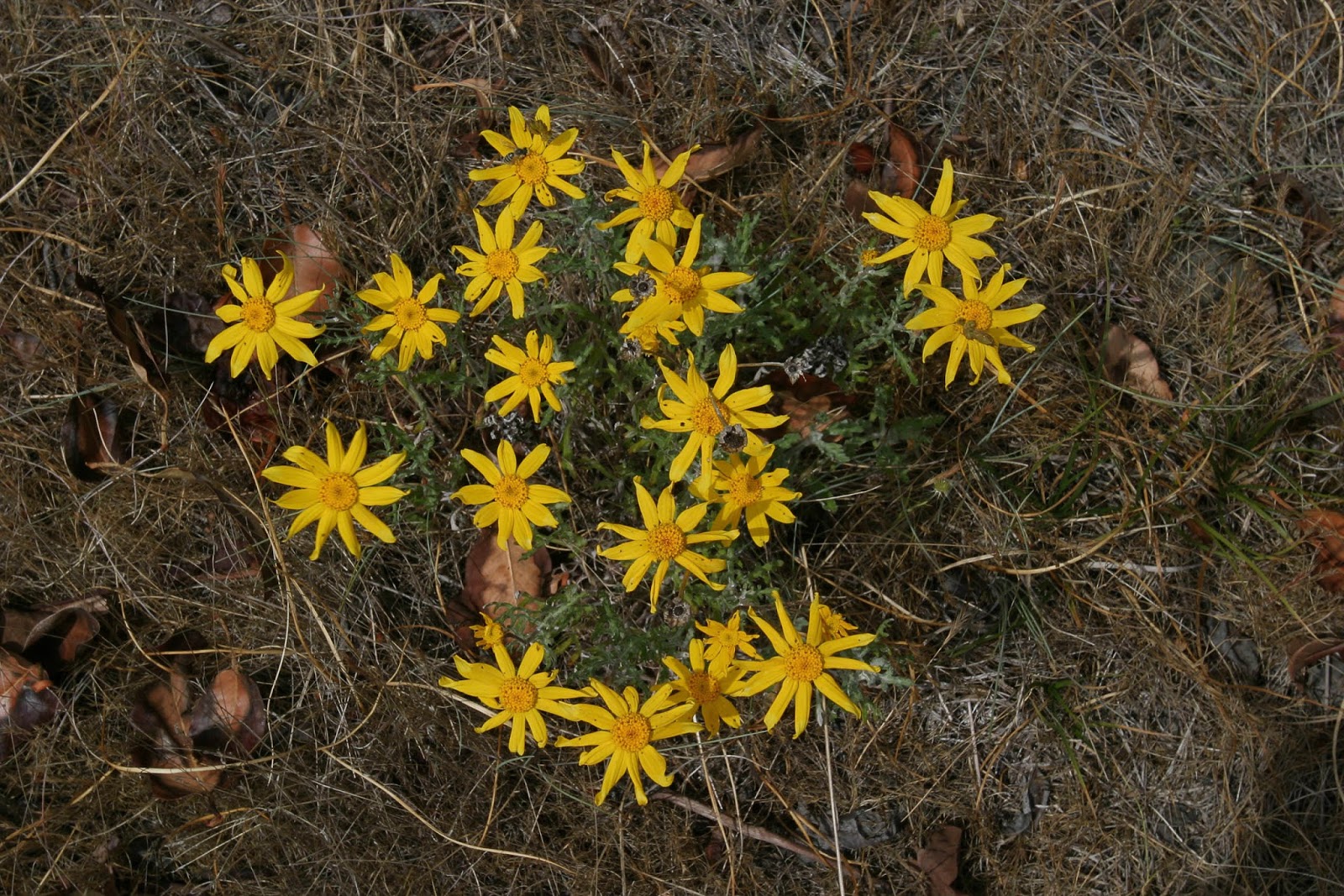
Oregon sunshine, aka wooly sunflower, (Eriophyllum lanatum) finally came into its own after a couple false starts in mid March and mid April. There are now large patches of what may be the brightest yellow flower Yellow Island has to offer.

Eriophyllum lanatum, wooly sunflower
Broadleaf stonecrop (Sedum spathulifolium) is about tied with the Eriophyllum for brightest yellow flower. My absolute favorite place on the island is the rocky area atop Hummingbird Hill that is covered with frilly reindeer lichen that forms a nice bed for the stonecrop. The combination of colors and textures cannot be beat.
Sedum spathulifolium, broadleaf stonecrop
A third bright yellow flower is Puget Sound gumweed. It appears across the meadows and rocky outcrops but is particularly thick on the south side of Hummingbird Hill.
Grindelia integrifolia, Puget Sound gumweed
Three non-yellow species that occur individually or in small groups are California broomrape (Orobanche californica), Hooker’s onion (Allium acuminatum) and harvest Brodiaea (Brodiaea coronaria). These cheery spots of color brighten a  meadow that is rapidly turning to brown (or some would say yellow as seen from a distance).
Orobanche californica, clustered broomrape
Allium acuminatum, Hooker’s onion
Brodiaea coronaria, Harvest Brodiaea
When all these species start fading, there are at least four species that have will bloom in June into July. Can you name them?

(This blog was written May 15 but never posted. Amazingly all species mentioned are still blooming nicely, plus a couple of the last four mentioned above.)