Tuesday, June 21, 2016

Mid June on Yellow Island


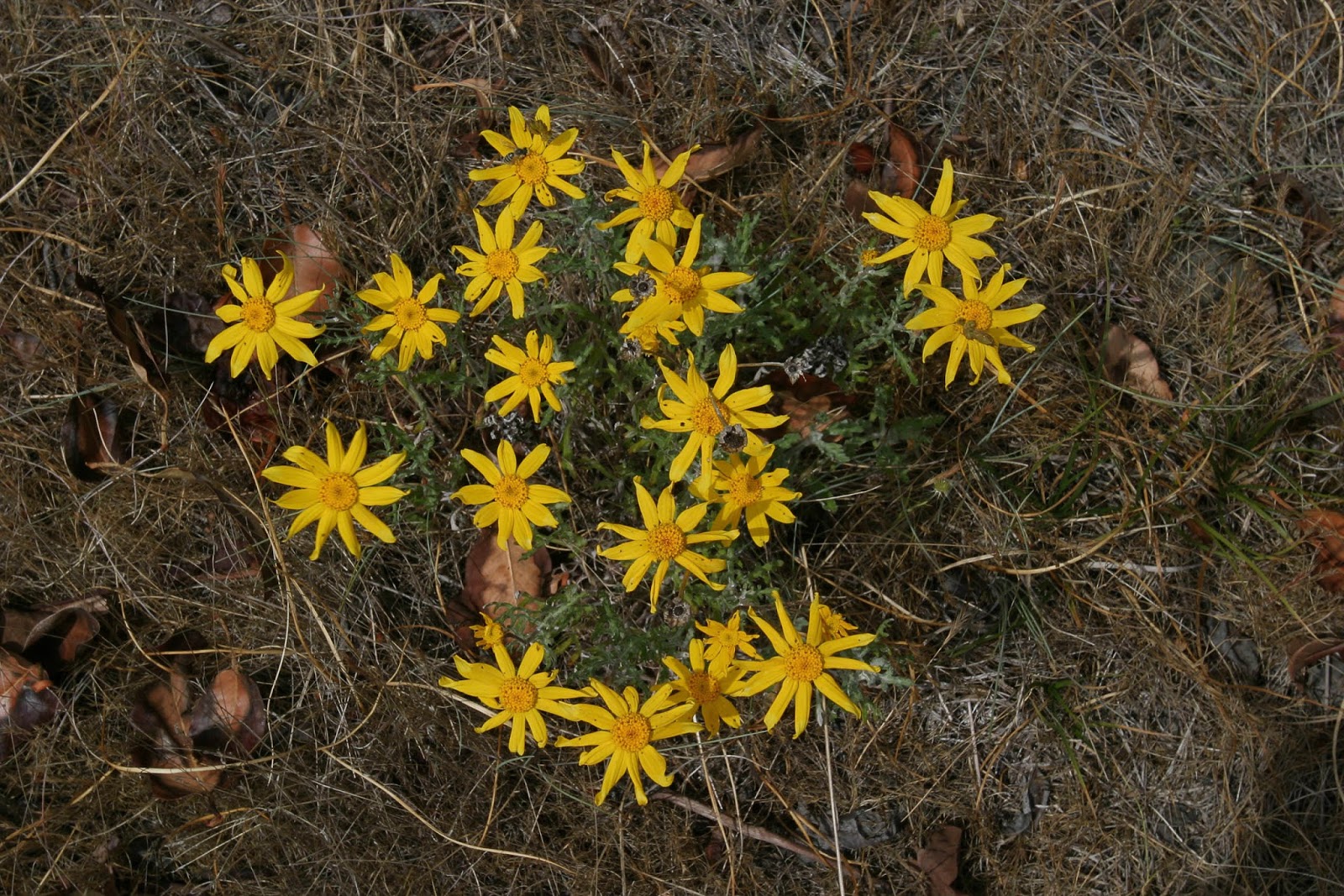
The meadows are looking very brown with just scattered splotches of color Other than two large pink patches of fireweed (Chamerion angustifolium) above the east spit and in the glade, small purple groupings of harvest Brodiaea (Brodiaea coronaria), pink nodding onion (Allium cernuum), and yellow Puget Sound gumweed (Grindelia integrifolia) provide color here and there. A few (<20) cactus (Opuntia fragilis) did their 24 hour pale yellow bloom thing before withering. Seaside rein-orchid (Piperia elegans) adds its white flowers to the flower mix scattered across the island.
Rufous hummingbird nectaring on fireweed


Harvest Brodiaea
Nodding onion

Puget Sound gumweed

Seaside Rein-orchid (photo from a previous year)
fMost days on Yellow I upload a bird list to eBird and there are now more than 3000 Yellow Island daily checklists online. Recently eBird allowed uploading audio files with the checklists and the audio will become part of the Macaulay Library of natural sounds. This inspired me to get serious about recording bird songs and calls. I upgraded my recorder and signed up for Cornell’s Bird Recording Workshop held at San Francisco University Field Station located at an elevation of 6000’ in the Sierras June 11-18. The director of the Macaulay Library, Greg Budney, was the lead instructor for the class. For seven days we got up at 0430 and went out to various sites to record birds. It was a fabulous vacation!
The following are some of the recordings of Yellow Island birds that I wake up to every morning. Enjoy! (One of the recordings is from San Juan Island. Can you guess which one?)
Western tanager and orange-crowned warbler: https://soundcloud.com/user-444804177/ocwaand-weta


Friday, June 3, 2016

Yellow Island’s third ‘peak bloom’


Early May saw the rapid disappearance of camas across the island but even as the camas was fading new species were blooming across the meadows and rocky balds.
Oregon sunshine, aka wooly sunflower, (Eriophyllum lanatum) finally came into its own after a couple false starts in mid March and mid April. There are now large patches of what may be the brightest yellow flower Yellow Island has to offer.

Eriophyllum lanatum, wooly sunflower
Broadleaf stonecrop (Sedum spathulifolium) is about tied with the Eriophyllum for brightest yellow flower. My absolute favorite place on the island is the rocky area atop Hummingbird Hill that is covered with frilly reindeer lichen that forms a nice bed for the stonecrop. The combination of colors and textures cannot be beat.
Sedum spathulifolium, broadleaf stonecrop
A third bright yellow flower is Puget Sound gumweed. It appears across the meadows and rocky outcrops but is particularly thick on the south side of Hummingbird Hill.
Grindelia integrifolia, Puget Sound gumweed
Three non-yellow species that occur individually or in small groups are California broomrape (Orobanche californica), Hooker’s onion (Allium acuminatum) and harvest Brodiaea (Brodiaea coronaria). These cheery spots of color brighten a  meadow that is rapidly turning to brown (or some would say yellow as seen from a distance).
Orobanche californica, clustered broomrape
Allium acuminatum, Hooker’s onion
Brodiaea coronaria, Harvest Brodiaea
When all these species start fading, there are at least four species that have will bloom in June into July. Can you name them?

(This blog was written May 15 but never posted. Amazingly all species mentioned are still blooming nicely, plus a couple of the last four mentioned above.)

Thursday, April 21, 2016

Mid April Flower Report

It's been over a month since the last post and a lot has changed. The early individual blooms of fawn lilies (Erythronum oregonum) exploded into large patches of stunning white flowers. This species peaked around April 1 and as of today there are just scattered blooms on the north side of the island.  Shooting star, (Dodecatheon pulchellum), also peaked around April 1 and is now mostly going to seed. This is a normal bloom pattern for fawn lilies and shooting stars.


Fawn lilies surround an old growth Douglas fir
A colorful clump of  shooting stars.
Harsh paintbrush (Castilleja hispida), western buttercup (Ranunculus occidentalis), and chocolate lilies (Fritillaria lanceolata) were also blooming a month ago. However, these species have persisted and now cover large areas of the island with their reds, yellows and shades of brown. Again, this is a normal pattern for these species which should persist into May.


Paintbrush line the trail
Chocolate lilies across the north side of the island.
One species that isn't showing a normal pattern is great camas (Camasia leichtlinii). Camas first bloomed March 24. The earliest bloom date over 30 years of record keeping was March 10, the latest April 20, with an average of April 4. March 24 is well within the normal range.  However, instead of showing a normal bell shaped curve of a gradually increasing bloom, peaking in late April, within ten days camas covered the island. Already many are starting to go to seed. We have had a stretch of unseasonably warm weather so this may be why.


Camas on the east side of Hummingbird Hill
One other major surprise was the first bloom on Nootka rose (Rosa nutkana). The average for Nootka rose is May 10. The previous earliest date was April 26. This year it was a week earlier, April 19. It should also be noted that Nootka rose was one of the species fooled last fall. About a quarter of the roses bloomed in the fall of 2015 due to unseasonably warm weather.

People always ask, well, how does this compare to other years. All years are different but for me, this was/is another five star year. Spectacular! Here's a sampling from the past week. Enjoy!


Sunday, March 13, 2016

Mid March Yellow Island Flower Report


It’s been several weeks since the last update so what has changed? While the red flowering currant and blue-eyed Mary may be at their peak now, several other species are just beginning. The first rufous hummingbird found the flowering currant on March 11.
Red flowering currant this week.
Blue-eyed Mary in a bed of camas.
The next species to flower was buttercup, Ranunculus occidentalis. It bloomed on February 14. While this is early for buttercup, the earliest first bloom date in over thirty years of recording was January 16 in 2009. However, that was a lone plant and the next individual to flower that year was two months later in mid March. This points out one of the problems of looking at first bloom dates. Do they indicate the start of the species blooming that year or are they reporting an anomaly? The latest first bloom date for buttercup is April 3, 1990.

buttercup sharing space with camas.
February 21 had two species show their first flowers of the year: harsh paintbrush (Castilleja hispida) and desert parsley (Lomatium nudicale). This is the earliest recorded date for both species. For paintbrush, it was six days earlier than last year February 27, 2015 that was the previous earliest bloom date. For the desert parsley, this was off the charts early. The previous earliest date was March 22, 2015, 31 days later! And this wasn’t just one plant. Three individual plants in the same general area all bloomed with in a day or two of each other.

Paintbrush and Roemer's fescue.

Lomatium blooming very early
Pacific sanicle (Sanicula crassicalis) bloomed two days later on February 23. This was also a week ahead of the previous earliest first bloom, March 3, 2015. Similar to the desert parsley and paintbrush, the previous record was in 2015. The latest first bloom for sanicle was April 14, 2000.

Pacific sanicle in bloom
It’s a leap year and two species celebrated by blooming on February 29: fawn lily (Erythronium oregonum) and prairie saxifrage (Saxifraga integrifolia). The earliest and latest bloom dates for fawn lilies is February 14, 2015 and March 25, 1985. For the saxifrage the corresponding dates are February 27, 2010 and April 15, 1982.
 
This patch of fawn lilies was the first to bloom the last few years.
As of this writing, only two other native species have bloomed: chocolate lily (Fritillaria lanceolata) on March 7 and shooting star (Dodecatheon pulchellum) on March 11. Earliest and latest for these two species are: Chocolate lily March 5, 1992 and April 10, 2008 and shooting star February 28, 2010 and April 3, 2009. For the shooting star it is interesting the extremes occurred in back to back years. Also for those two species I’ve only found two plants of each in bloom so far.
One of two chocolate lilies blooming
One of two shooting stars blooming

While there are several hundred fawn lilies and several dozen paintbrush and buttercups, the island is far from colorful. The flowering currant and blue-eyed Mary still provide the majority of the color with fawn lily a distant third. But how patriotic: red currants, white fawn lilies and blue-eyed Marys.

(Unlike the last post, all photos are from 2016.)

Saturday, February 13, 2016

Early Blooms on Yellow Island

Early February and what’s happening on Yellow? Are the flowers getting ready to bloom? Amazingly we have a couple species that have been blooming since last November. The strange fall weather that closely mimics spring weather definitely fooled two very different species.
Red flowering currant (Ribes sanguineum) was found in bloom in mid November. Because I don’t look for first bloom dates in November, the exact date is a mystery. Ribes is a shrub so it is easy to follow individual plants. Those that flowered in in November, perhaps 10% of those on the island, have lost their flowers now. But of those that didn’t bloom in 2015, the first bloom I noted this year was January 30. And here we are on February 13 with most of the individual plants showing some flowers. I always think of the rufous hummingbirds arriving to take advantage of the early currant blooms. However, this year the blooms are too early and the hummer taking advantage is an Anna’s hummingbird that over wintered on Yellow. (That is another first for Yellow Island.) 


Another very different species is blue-eyed Mary (Collinsia parviflora). Likewise it bloomed in mid November and has stayed in bloom every since. Unlike Ribes that is a perennial, Collinsia is an annual and forms small blankets of flowers over the rocky areas. It’s a nice touch of color on grey winter days.


All northwesterners know winter is the rainy season. With all the rain, winter is also the greenest time of year with various mosses and licorice ferns adding numerous bright shades of green to the rocky outcrops. Add to the mosses the very healthy off white colored reindeer lichen and the multiple hues of the broadleaf sedum (Sedum spathulifolium) and the rocks atop Hummingbird Hill can be a photographer’s paradise.


Within a month or so the lilies that have already broken ground will start to bloom, tourists will start arriving, and the flowering season will begin exploding in earnest for another year. 

(Note the flowering currant and blue-eyed Mary photos are from previous years later in the season.)

Friday, January 11, 2013

Table manners of bald eagles on the Nooksack River

Most of my island friends don't know my career with TNC started as the Bald Eagle Survey Coordinator for the Skagit and Sauk Rivers. Once a week we canoed the Sauk River from Darrington to Rockport, did a survey along the road on the Skagit from Marblemount to Rockport and dispersed up to 25 volunteers to record night roost activity on both rivers. Simultaneously the NPS surveyed the Skagit above Marblemount while the USFS surveyed it from Rockport to Sedro Woolley. This is how I spent my winters from 1998 to the winter of 2004-2005. Somewhat amazingly I don't have any photos in my collection of eagles from that time.

Last week friends Traci Walters and Chris Teren were photographing eagles on the Nooksack River and discovered a leucistic eagle. I decided it was a worth a trip up river to see if i could find and photograph it too.

It was a cold, sometimes drippy day. When I arrived there were already three other photographers present. I immediately spotted the leucistic eagle; it was several hundred yards up river so not readily photographable. The following show three eagle plumages: adult, juvenile and leucistic.


When I did a quick count scan with my binoculars I noted that there were over 80 eagles in this one location. It was late in the morning so most of the feeding activity was done for the day. But there was one chum carcass that became the center of the eagle activity for the next 15 minutes


One adult eagle, with great effort, pulled the carcass on a log.


But just when you think you're alone, here comes company.


Eagle number one maintained control but then along came eagle number three.


Eagle #1 made it clear to the other two this was its fish. But alas, along came eagle #4 bumping #1 off the carcass.


Eagle #4 got the fish but then along came eagle #5.


And when #6 arrived parts started falling in the water and #4 left with a piece.


Note throughout how eagle #3 on the far right is craning its neck to follow the action.

As the remains got smaller and smaller, the action really picked up; it was clear if an eagle wanted to eat, it needed to act now.


Pieces fell in the water and that divided the action.


A juvenile arrived and took its place at the end of the line.


More pieces were carried off.


The juvenile even reached in and grabbed the skin.


 About now the leucistic eagle decided it wanted in on the action.


The other eagles didn't argue with it at all. But there wasn't much left. The following sequence shows three different plumages, adult, juvenile and leucistic.


As the eagles dispersed I was jockeying for position with the other photographers and hoping for one last 'make my day' photograph. Alas, too much going on and I wanted to cry when I looked at the blurry image of the eagle flying closer to me than it had been all day. 


This best image of the day of the leucistic eagle.