Monday, June 18, 2012

Spring's Solstice Swan Song

With the summer solstice just a couple days away, spring's wildflower season gives way to the flowers of summer. Of course some species overlap both season's unconcerned about the calendar.  The yellows of mid to late spring, broadleaf stonecrop (Sedum spathulifolium) and woolly sunflower (aka Oregon sunshine) (Eriophyllum lanatum) fade into another round of yellows: Puget Sound gumweed (Grindelia integrifolia) and lance-leaf stonecrop (Sedum lanceolatum). Amazingly several western buttercups (Ranunculus occidentalis), first blooming in March,  are still in flower although I have already collected some buttercup seed.
Broadleaf stonecrop (lower left) and woolley sunflower

Puget Sound gumweed


Lanceleaf stonecrop
Likewise, another March bloomer, harsh paintbrush (Castilleja hispida), still offers patches of bright red on the north side.  But the main colors joining the yellows are the pinkish purples of the two onions, Hooker's onion (Allium acuminatum) and nodding onion (A. cernuum)

Hooker's onion


Nodding onion

Nodding onion

plus the another shade of purple from harvest Brodiaea (Brodiaea coronaria) 
and fireweed's (Chamerion angustifolium) deep bright pink.

Harvest Brodiaea

Fireweed

Clustered (or California) broomrape (Orobanche californica) is very rare but also part of this color scheme.
Clustered broomrape

Even yarrow (Achillea millefolium) has a pink version but the white is far more common.
Yarrow (light pink form)
Yarrow (white form) and nodding onion

A few white flowers from spring can still be found if you look closely. Western starflower (Trientalis latifolia) and field chickweed (Cerastium arvense) add spots of white here and there. The white flowered serviceberry is forming berries and its white flowers are replaced by the native shrub oceanspray (Holodiscus discolor).
White-crowned sparrow atop oceanspray.
Even the beach areas offer bits of color. Sea rocket (Cakile edentula, native, and C. maritima, non-naitive) offer a pale purple hue to the high intertidal
Cakile maritima

Cakile edentula
while Japanese beach pea (Lathyrus japonicus) shows off its bicolored purple.
Japanese beach pea

Do these represent the end the end of the flowering season? Not quite. Two species that have yet to bloom are brittle prickly pear cactus (Opuntia fragilis) and seaside rein orchid (Piperia elegans).


My plan had been to walk around today photographing all these species but alas it has been raining the past couple days. All the above photos are file photos from previous years.

Friday, June 1, 2012

Rufous hummingbirds through the flowering season

As I was sitting out in the morning drizzle enjoying my morning cup of coffee, I noticed the first flowers blooming on snowberry, Symphoricarpos albus. That is what got me thinking about the various plants I've seen rufous hummingbirds nectaring on. I had always thought hummers liked long tubular flowers. Boy, was I wrong! I looked back through my photo files and my first recorded event was in 2004 at my home in Mount Vernon. This hummer was nectaring off Ceanothus.

Since being on Yellow I have photographed them on several plants but not all that I've seen them nectar on.  The first bit of luck was with harsh paintbrush, Castilleja hispida. 


Castilleja blooms from late March into June so gets a lot of use by hummers. During that  same time frame camas, Camassia leichtlinii, is in bloom from early April until mid May. It's another hummingbird favorite.


After the camas and paintbrush are done flowering for the year, a couple late season bloomers take over. Fireweed, Chamerion (fomerly Epilobium) angustifolium, is a favorite and blooms mainly above our east spit. Quite often it is the only flower in bloom and the hummer that has staked its territory there spends much of his time defending it (quite unsuccessfully) against the other four to five pairs of hummers on the island (along with their young.)
Fireweed has yet to bloom this year but when it does, this is one photo that needs improving on.

The snowberry that got me thinking about this is also visited by hummers when all else fails. This can last into July when the males have already left and this year's young are abundant.


I've always associated the arrival of rufous hummingbirds with the flowering of red flowering currant, Ribes sanguineum. In actuality on Yellow, Ribes flowers well before the hummers arrive, sometimes up to a month before. But when the males do arrive this is the species they favor. Another early bloomer is fawn lily, Erythronium oregonum. I've only seen it once but was with a friend who documented a rufous hummingbird nectaring on it. Late season a third plant that I have yet to photograph hummingbirds using but know they do is orange honeysuckle, Lonicera ciliosa. Finally a tubular flower that hummers use on Yellow. I watched one the other day in perfect light but alas the camera was half an island away.

So a couple goals: this year photograph hummers on honeysuckle and fireweed, next year on flowering currant and fawn lily.

PS Yes, I was having coffee in the rain and these are the first blooms of snowberry this year - sans hummingbirds.


Tuesday, May 22, 2012

Got White Camas?

This was originally post in May of 2012. I have the same conversations with visitors every year so am re-posting  for those that may have missed it.

Sunday a woman came on a beeline to me; clearly see had something on her mind. She had a Native Plant Steward hat on and I guessed correctly the question would have to do with plants and not all those nasty Yellow Island rules. She said "I decided to go straight to the source. You told me a couple years ago there was a white version of the edible camas. My friends say I'm crazy." This is similar to another question I get: "Do you have the white camas?"

Camas does indeed have two forms: great camas (Camassia leichtlinii subsp. suksdorfii) and great white camas (Camassia leichtlinii subsp. leichtlinii). The two subspecies are identical with the exception of flower color and yes, both are edible.The following shows the two flowers side-by-side.


But what happens when these two cross. I'm not an expert here but the following two photos show two very different possibilities, if in fact that is what happened.

The first possibility is purple petals outlined in white.


A second possibility is this very pale purple version.


So where does death camas (Zigadenus venenosus) fit in? When visitors ask if we have the white camas, this is usually what they mean. The following shows great camas and death camas side by side. The flowers are very different so when in bloom or seed, the species would be obvious.


However, not every plant blooms every year and the leaves and bulbs are nearly identical. So my question to you readers, how comfortable would you be harvesting from the following meadow after the flowers are gone?


Sunday, May 20, 2012

Setting Fire to the Rain

When Adele sang Set Fire to the Rain, I'm pretty sure she wasn't singing about the weather. But the title seemed appropriate. After a week of absolutely fabulous spring weather, the forecast for the next week is rain and wind. Not to be deterred by a little inclement weather I headed out to set my own fire to the rain and enjoy the beauty of Yellow Island on this overcast, sometimes misty, drippy day that will be remembered as the day we couldn't see the annular eclipse.

The meadow is definitely fading but is still covered in flowers with more subtle colors; the faded reds of paintbrush (Castilleja hispida) and muted yellows of desert parsley (Lomatium nudicale) represent the valley between flower peaks two and three. From the top of Hummingbird Hill looking east,south and west, the scene is similar to the photo below.


Closeups of this combination are also very nice.


Camas and buttercups are mostly gone but the final burst of color will come from the bright yellow stoncrops (Sedum spathulifolium) on the rocks, the even brighter yellow of Oregon sunshine (Eriophyllum lanatum) plus the white and sometimes pink of yarrow (Achillea millefolium).

Broadleaf stonecrop has been blooming for over a week but has yet to reach its peak. The rocks are covered in lichens, mosses and sedums that will only get more colorful over the next week.


With the breeze today stonecrop is a good plant to photograph because it doesn't blow around too much in the wind. Plus it is probably my second favorite flower to photograph after shooting stars. The following are a few groupings that caught my eye.


And finally, Douglas firs invading the meadow are usually pulled immediately after being found. But this one on the rocks with mosses, lichens, fescue and sedums will most likely be thinned by Mother Nature.


Almost forgot to mention that the roses (Rosa nutkana) started blooming this week. Just another reason to go out in the rain.


As my friends at NCI say to their students, there is no such thing as bad weather, just inappropriate clothing. Get out and enjoy!

Friday, May 18, 2012

Photographing Plant Phenology

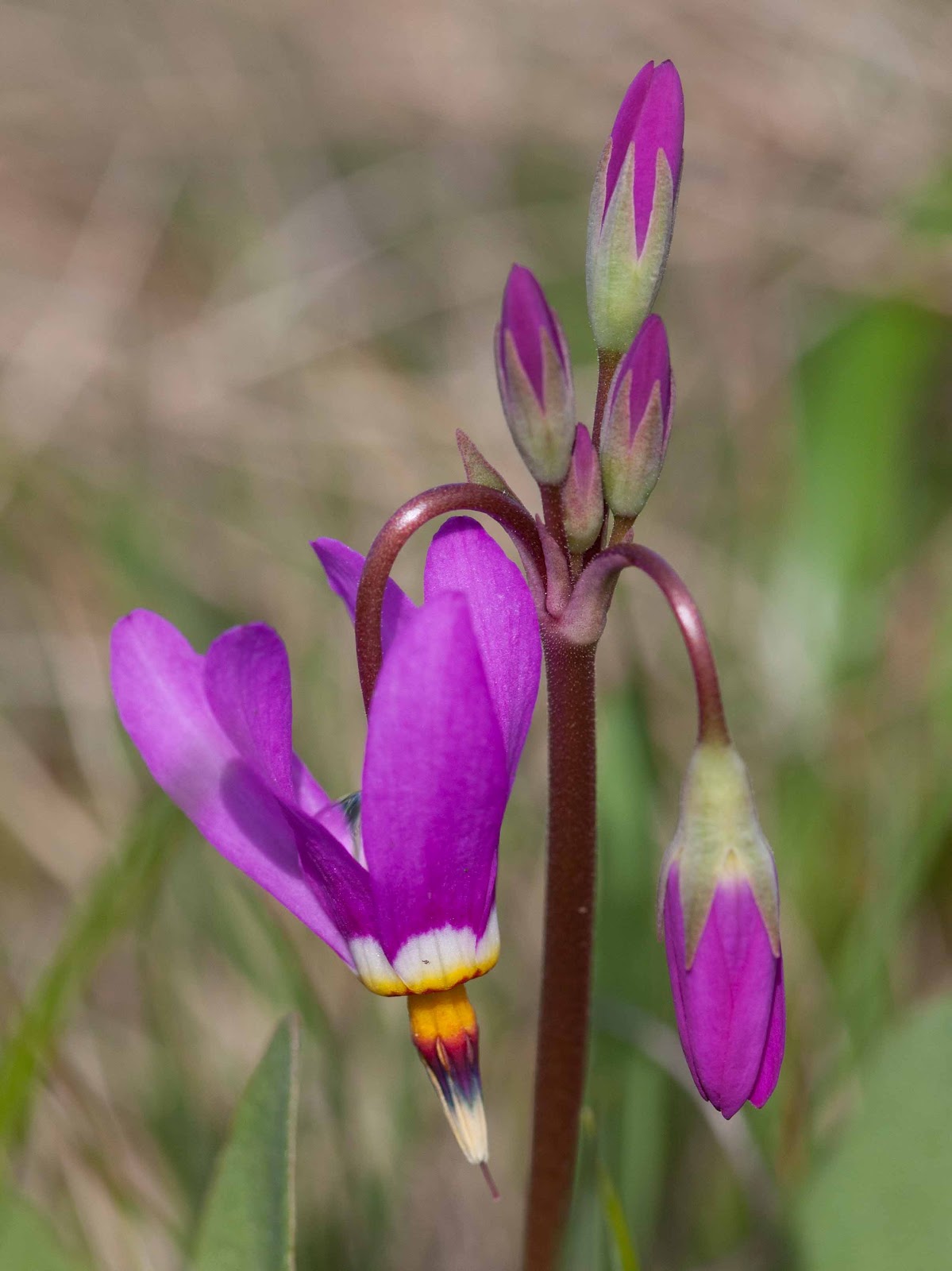
Several years ago I took the following photograph (on film no less) and it started me wondering how often can you see bud to seed on an individual plant with all the stages in between?  Shooting star, Dodecatheon pulchellum, I find one of the most photogenic flowers.  This particular specimen shows bud, flower first opening down, petals spreading wider as the flower angle changes, flower going horizontal before turing vertical with petals beginning to drop and finally petals gone.  It is missing the final stage of an actual seed pod.


When I looked at this photo later, I wished it weren't so fuzzy and a little more artistic. I have been searching for another such individual ever since. The search continues.

But what other species might this phenomenon occur where all stages of the plants flowering phenology can be seen on one individual plant. Clearly single flowered species like most fawn lilies, Erythronium oregonum, can't, but what about the multi-flowered chocolate lily, Fritillaria lanceolata?  I have seen buds and flowers in both the yellow and brown subspecies as illustrated below but never bud-flower-seed pod.


Enter a third member of the lily family, great camas, Camassia leichtlinii, highlighted in the last blog. Camas always has multiple blooms per stem and blooms open from the lowest to highest in sequence. When the middle buds have opened to flowers, the lower flowers have gone to seed while the top buds are still buds.


Other examples of this come from plant families as varied as cactus and roses.  Each of the following photos comes close but neither quite makes it to all stages.


Here the bud and flower of brittle prickly pear cactus, Opuntia fragilis, are obvious with the shriveled flower between but not really a seed pod yet.

Nootka rose, Rosa nutkana, also comes close to showing all stages but alas the rose hip can be seen developing but not the final stage. Three out of four stages: bud, flower, petal drop, but where's the hip.


Photographers give themselves all sorts of projects to stay motivated.  The great thing about this project is that it will never end. Plus it always keeps me looking and interested in the amazing diversity of the plant world.

Back to the shooting star - the following is the closest I've come in many years of searching, the first showing various stages of the bud, the second stages of the flower, but nether with seed pods etc.


The journey continues!

Sunday, May 13, 2012

Why not Purple Island?

Every year I get the question "Why is it called Yellow Island?" The question that should be asked this time of year is "Why isn't it called Purple Island?"

What makes Yellow Island different from most other San Juan Islands are the native prairies. The prairies exist because Native Americans burned the island for millennia, possible since the last ice age. The island in essence co-evolved with a human presence. The purpose of the burning was to keep the understory in check so forbs could flourish. Great camas, Camassia leichtlinii, was a food staple in the Coast Salish diet and the second most heavily traded item among coastal indians, second only to salmon. Today camas is still a dominant species of the Yellow Island ecosystem.

The Nature Conservancy has burned two to three acres of Yellow every year since 2002. The following photos illustrate how camas dominates just about all areas of the island, especially a year or two after a burn.

The north side of the island was burned in 2006. This photo looking east to McConnell Island was taken in 2008. The photo below was taken the same year looking south, up the north side.


The fall of 2009 the west meadow was burned and the photo below was taken the following spring.


September of 2010 the east meadow was burned resulting in this 2011 photo.


Even areas of the island that are never burned are dominated by camas. A planted garden area at the top of the steps was totally overgrown with snowberry. In 1995 the steward removed the snowberry and was amazed the following spring when a bed of camas appeared. The following photo was taken on May 11 this year.


After years of taking camas photos, the question I always ask myself is "do I need another camas photo?" Then you see one in perfect light:


Or one with a bee landing:


Or one with a hummer nectaring:


Or one in overcast light saturating the colors:


And then I look back and say "well the bee photo had too much depth of field, that hummer was too fast and isn't quite sharp, could I find one on an overcast day with more flowers per stem ..."  There will be reasons to photograph camas for as long as I'm steward of Yellow (aka Purple) Island.